The infrastructure layer
for aging in place.
Nova Templum combines recurring monitored subscribers, connected devices, monitoring infrastructure, AI-enabled engagement, care coordination and dealer-enabled distribution into one connected operational ecosystem — powered by ResQHub and surfaced through Pulse Alert, TruAlert, CareLink and ResQAi.
One ecosystem.
Multiple infrastructure layers.
Nova Templum is not a speculative new healthcare category. It is real operational infrastructure being assembled around a market that already exists, already generates recurring revenue, and is consolidating toward integrated connected-care platforms. The differentiation is not AI alone — it is the integrated operating ecosystem underneath.
North America is entering one of the largest demographic shifts in modern healthcare. The senior population is growing rapidly while caregivers and long-term care infrastructure face mounting pressure — and most older adults strongly prefer to remain in their homes. The future of aging in place depends on integrated operational ecosystems, not disconnected standalone products.
- remote monitoring
- wellness engagement
- caregiver communication
- medication adherence
- emergency response
- care coordination
Major acquisitions across medical alert, remote monitoring and connected care validate the long-term value of recurring subscribers, monitoring operations, device ecosystems and care-at-home infrastructure. The market is rewarding integrated operational ecosystems.
Most solutions only solve
one piece of the problem.
North America is entering one of the largest demographic shifts in modern healthcare. Seniors overwhelmingly want to age in place — but the current ecosystem is highly fragmented, with most companies solving only monitoring, or hardware, or engagement, or coordination in isolation. Families and caregivers are left stitching disconnected systems together.
The traditional medical-alert industry is evolving far beyond emergency response. Modern aging-in-place infrastructure requires GPS-enabled devices, fall detection, caregiver connectivity, AI-assisted engagement, medication reminders, centralized device management and recurring service layers — all operating as one system.
to connected-care infrastructure ecosystem.
Nova Templum is not inventing a new healthcare category. It is assembling real operational infrastructure for a market that already exists, already produces recurring revenue, already has strategic buyers, and is already consolidating toward integrated connected-care platforms.
Four brands.
One platform underneath.
The ecosystem looks like four separate companies from the outside — a Canadian PERS dealer, a hardware-and-support brand, an AI care companion, and a soon-to-launch in-house monitoring station. From the inside, they share one operational backbone: ResQHub.
One customer.
Every layer connected.
The ecosystem is designed around the customer lifecycle — not around isolated products. From the first lead to ongoing recurring care, every workflow is already operating today across Pulse Alert, TruAlert, ResQHub, ResQAi and CareLink. Real operational infrastructure, not theoretical workflows.
One platform.
Four stackable services.
Up to $10.50 ARPU per device, per month.
ResQHub bills every dealer per active device, per month. The base tier is connectivity and device management; SIM, monitoring and AI care are additive services that compound on the same active device. The economics scale linearly with the fleet — and the fleet runs on infrastructure that's already in production.
One infrastructure.
Every brand rides on top.
ResQHub is not a single app — it's a shared platform that unifies device telemetry, SIM lifecycle, monitoring-center integration, caregiver alerts and AI follow-up across every consumer brand in the ecosystem.
Shared SQL. One queue.
Worker roles doing real work.
The platform is built on an Azure-centric stack: Azure SQL as the system of record, Azure Service Bus as the decoupling seam, Redis for connection routing, and Azure Table Storage for telemetry — all wired through .NET worker roles that have been hardened in production for years.
- TCP listeners
- Protocol parsers (EV05, EV07, RTOS)
- Redis-routed sessions
- Per-instance memory caps
- Azure Service Bus
- EventsQueue (single seam)
- ResQBus worker pool
- Programming queue (commands)
- Azure SQL (shared schema)
- Cosmos DB
- Azure Storage / Table logs
- ASP.NET Identity + roles
A live command center
for every device in the fleet.
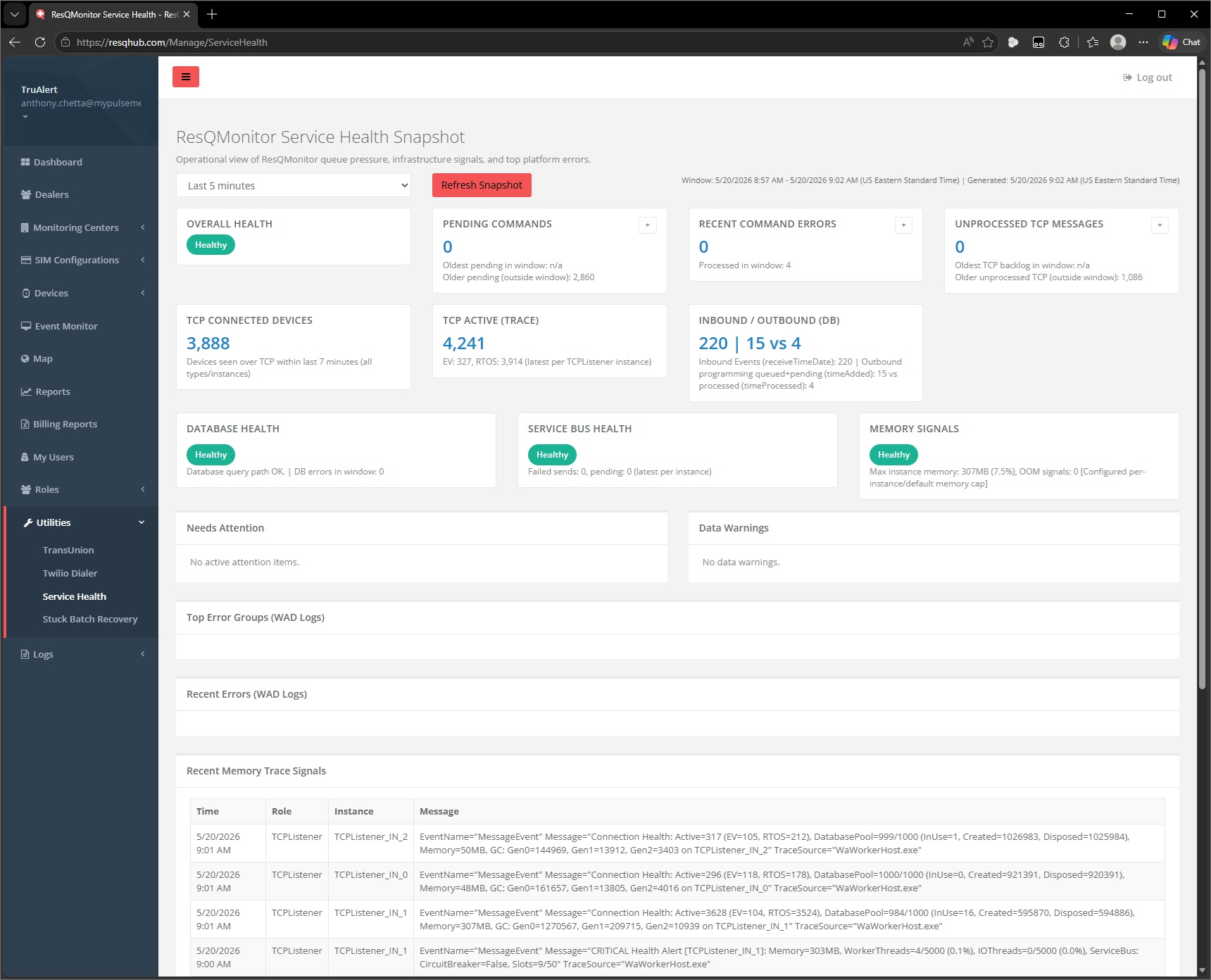
Dealers and operators get a single interface for activation, connectivity, event history, location intelligence, remote programming and diagnostics — across thousands of devices, multiple device types and a full sub-dealer hierarchy.
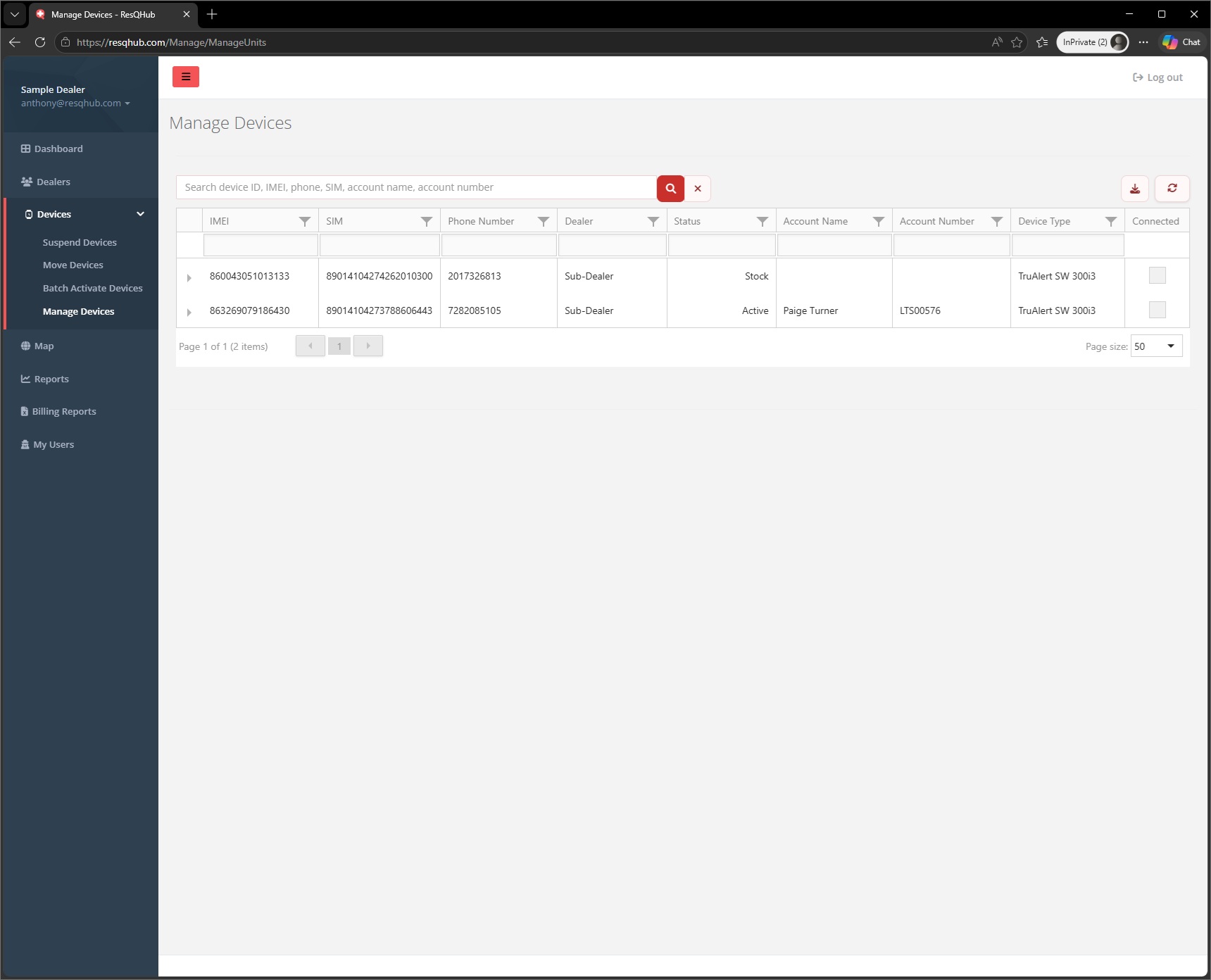
- ›Manage Devices· Inventory & status· Dealer assignment· Connection state· Bulk activate / suspend
- ›Device Detail· Event history· Location & accuracy· Battery / signal / data· Programming queue
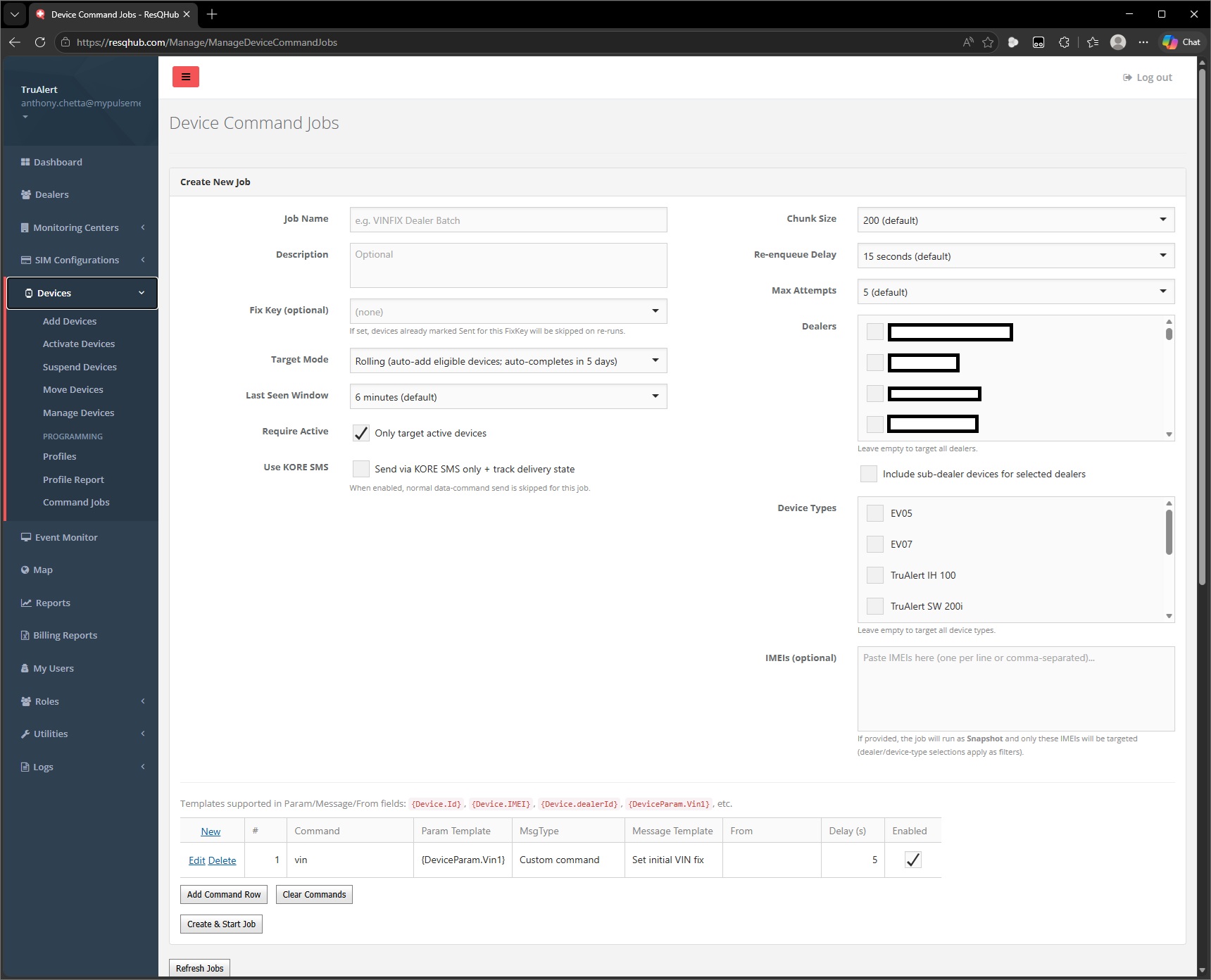
- ›Remote Programming· Reboot · Ring · Locate· DND windows· Fall sensitivity· Time zone / screen messages
- ›Device Command Jobs· Bulk rolling targets· Sub-dealer scoping· Chunking + retry policy
- ›Firmware & Models· EV04 · EV05 · EV07· IH100 · 200i · 300v · 300i3· Parser version
- ›SIM Inventory· Multi-carrier pools· ICCID / IMSI lookup· Carrier swap
- ›SIM Lifecycle· Activate · Suspend · Resume· Plan changes· BYO-SIM dealers
- ›Usage Telemetry· Data MB / Minutes· 30-day averages· Outlier flags
- ›Phone Numbers· DID assignment· Number porting
- ›Accounts· PII vault· Home radius· Medical notes
- ›Caregivers· Up to 5 contacts· SMS / email / voice prefs· Text-to-command access
- ›Monitoring Account· Central-station mapping· Account codes· ResQMonitoring (in-house)
- ›Event Stream· SOS · Fall · Battery · Geo· Enriched payloads
- ›Alert Routing· Central station· Caregiver fan-out· AI follow-up
- ›No-Report Queue· 7-day silence flag· Operator workflow
- ›Dealer Hierarchy· Master → Sub-dealer· Device ownership· Visibility scoping
- ›White-Label· Logo / colors / URL· Outbound message branding
- ›Users & Roles· Support · Billing · Monitoring· Permission matrix
- ›Per-Device Billing· $1.50 connectivity & mgmt· +$2 managed SIM· +$2 monitoring· +$5 AI care (ResQAi)
- ›Invoices· Stripe· QuickBooks Online sync
- ›Dealer Statements· Active counts· Service tier mix
- ›Call Campaigns· Welcome · Wellness · Medication · Post-event
- ›Transcripts· Risk scoring· Human-escalation queue
- ›CareLink Front-End· Family-facing UI· Daily summaries
- ›Operational· No-report 7d· Avg battery life· Data-by-device
- ›Commercial· Active device counts· ARPU per dealer· Churn signals
- ›Exports· PDF · Excel · CSV
- ›Service Health· DB · ServiceBus · Memory · Ingest
- ›Audit Logs· User actions· Programming history
- ›API Keys & Webhooks· Partner ingress· Outbound delivery
SIM, carrier and signal —
orchestrated as one.
ResQHub abstracts away the complexity of multi-carrier cellular. The platform manages SIM activation, suspension, phone-number assignment, SMS fallback, and per-device data/minute tracking — so dealers stop juggling carrier portals and spreadsheets.
Every signal becomes
an actionable event.
When a device fires an SOS or fall, the platform doesn't just forward a raw alert. ResQBus enriches it with location context, home-radius comparison, recent battery and signal history — then routes to monitoring centers, caregivers and AI follow-up in parallel.
ResQAi turns the
press of a button
into a daily relationship.
The same infrastructure that routes emergencies also powers ResQAi — the AI care backbone behind CareLink, the family-facing experience. AI calls are placed to the senior's mPERS device, transcribed, parsed for risk, and escalated to a live care team within 12 hours. Every conversation feeds the same shared data model that powers dealer dashboards and the CareLink app.
See the full CareLink investor briefing →Built for channel scale.
Master → sub-dealer → user.
Master dealers create sub-dealers, assign devices, manage users, and control visibility — each sub-dealer sees only its own devices, maps, reports and users. Master dealers retain full visibility. Branding, URL, color, and alert messaging are configurable per partner.
Already wired to the
systems that run the business.
ResQHub doesn't sit beside the operating stack — it's already integrated with the carriers, billing platforms, mapping providers, central stations and communication channels dealers actually use.
- ·Telit SIM lifecycle (default carrier)
- ·SMS fallback path with delivery tracking
- ·BYO-SIM for dealers with their own carrier accounts
- ·Per-device usage telemetry
- ·Stripe billing for dealer subscriptions
- ·QuickBooks Online sync
- ·Plaid for dealer account verification
- ·Per-active-device monthly billing
- ·Twilio SMS + voice
- ·SendGrid email
- ·Caregiver text-to-command (track, ring)
- ·Central-station event payloads · ResQMonitoring
From tens of devices to
tens of thousands — without proportional headcount.
The platform is engineered for fleet growth that doesn't require linear support growth. Asynchronous orchestration, queued commands with retry, and remote diagnostics mean a single operator team can manage exponentially larger fleets — turning PERS from a hardware-led business into a software-enabled one.
The data we already capture
becomes the next product line.
Built around recurring
operational infrastructure.
The objective is not device sales. The objective is integrated operational infrastructure supporting the long-term evolution of aging in place — anchored in recurring monitored revenue and compounding through layered services on the same subscriber.
Every layer scales.
Annual revenue compounds.
The ResQHub stack monetizes the same subscriber across five recurring layers — base platform, connectivity, monitoring, CareLink consumer engagement, and the connected-services marketplace. Each layer steps up year-over-year as premium tiers attach, AI engagement deepens, and the senior-intent dataset feeds high-intent referrals. As SME dealer partners ramp toward a 20,000 devices / month activation run-rate, total ecosystem ARR moves from single-digit $M in Y1 to a 9-figure run-rate by Y5.
CareLink parses every AI call for risk signals, service needs and lifestyle intent. Each signal becomes a trusted referral into a vetted partner network — fulfilled with the senior's trust already earned. Marketplace economics compound on top of the recurring ResQHub stack.
SMEs run the long tail of the PERS market and are structurally under-platformed. Each new SME dealer onboarded to ResQHub brings their full subscriber base onto the same recurring stack — billing, SIM, monitoring, AI, marketplace. The model assumes progressive SME onboarding ramping to a steady-state of 20,000 net-new activated devices per month by Y5, compounding into a ~340k active device base.
Per the CareLink investor briefing: senior safety subscription $39–$59 / mo, family dashboard $12–$24 / mo, plus add-ons (Cognitive Companion $19, Med Adherence+ $9, Vitals Sync $29) and connected-services rev-share — a 2.6× lift on attached accounts across 129,597+ AI calls YTD.
investor.pulsealert.ca →Projection figures are illustrative. Annual revenue per stream = in-year average active devices × monthly per-device contribution × 12. CareLink ARPU and marketplace economics anchored to the PulseCareLink briefing; device ramp assumes SME-led distribution reaching ~20k net-new activations / month by Y5.
The operating system
for connected safety.
ResQHub turns hardware-heavy, support-intensive PERS into a scalable, software-enabled operations layer. It powers every brand in the ecosystem — Pulse Alert, TruAlert, CareLink and ResQMonitoring — from one shared infrastructure that already runs 22,000 devices at fleet scale, with the integrations, dashboards and orchestration in production today.
We are not just managing devices. We are operating the infrastructure that makes aging-in-place possible at scale.